
If you are new to therapy or returning to it after a break, it’s normal to wonder what to expect in the first session. You might be worried about not knowing what to talk about, or feeling awkward or uncomfortable.
As an experienced therapist I’m aware that first sessions can be anxiety-provoking, and will help ease you into the process.
All therapists work differently but this is what you can expect when you come to see me for the first time. More often than not, I start with a brief phone call before we arrange to meet. This is so we both get a sense of each other. For me, it’s an opportunity to hear more about what you are hoping to work on in therapy and what type of therapy you might be hoping to have. This helps me to understand if the way I work could be helpful for you. For you, it’s a chance to experience what talking to me feels like and to get an idea of how we might work together.
If we decide to meet for a full initial session in person or online, this usually takes place quite quickly – as long as our availability matches and I have space for new clients, you can expect to see me within a week or so from first making contact.
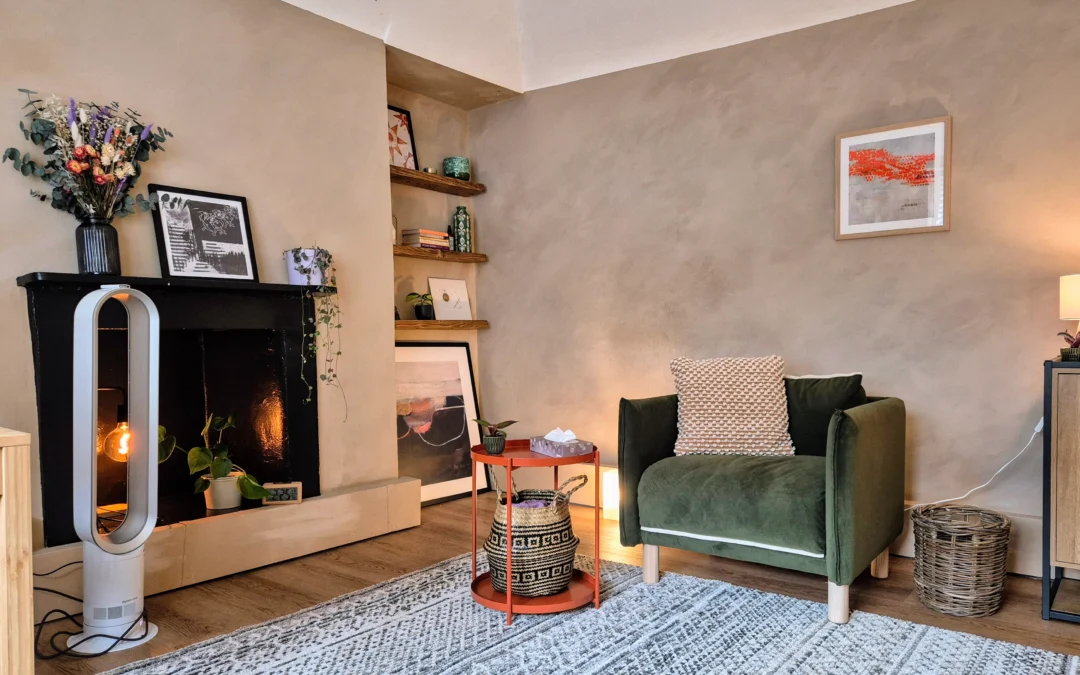
My therapy room is based in a small building that also houses other small businesses. It’s a discreet, professional space. There is no reception and you won’t need to speak to anyone else; I will give you instructions to ring my doorbell and come up to my room.
What I do:
The initial session is a chance for both of us to decide if working together would be helpful for you. I usually start by letting you know how I structure initial sessions; if you’re happy to do so, I invite you to start by telling me more about what it is that brings you therapy at this time. As you talk, I will likely ask some clarifying questions or more details about things that feel important, and reflect back to you my understanding of the situation. This helps me to start getting to know you, and also gives you an idea of how working with me might be like.
As a psychodynamic therapist, I’m interested in all aspects of your life. Some of the themes I might ask about include: your family background, your current relationships, how your current difficulties are impacting you, what you have tried previously (e.g. previous therapy, any medication, your self-care routines etc.) and how you hope things could change if you continued in therapy.
I will have sent you a copy of my therapy agreement in advance. This is a document that gives you all the important information you need about my professional memberships and my responsibilities to work ethically, handle your information in the strictest confidence, and to have adequate professional supervision to support my work. It also gives you information about my cancellation policy, usual holiday times, payment details and other details that set out the practicalities of what you can expect from me as your therapist. I usually go through the main points briefly in our initial session and if there is anything you are unsure about, we can talk through it together.
What I don’t do:
I don’t use assessment forms or questionnaires. If you have previously had therapy through a service in the NHS, workplace, university or charity, you might have been given different forms to fill to rate your current mood and symptoms. You might also have been asked a list of questions. In private therapy, I prefer not to use these and instead, get to know you more naturally through our conversations.
I don’t leave you in long silences if talking feels difficult. I might not fill every empty second because space is sometimes useful so we can both think, but I won’t just sit there and wait for you to talk if you are finding it hard to know what to say next. I will help you with questions and comments to expand on the topics you have shared.
I also won’t ask you to talk about anything you’re not ready to go into yet. While it is very helpful to get a general overview of things that have brought you to therapy, I don’t expect you to share anything that feels traumatic, shameful or difficult to share at this point. I think trust is built over time, it isn’t instant.
I don’t make promises about a specific outcome or timescale. If I agree to take you on for ongoing therapy, I do so because I genuinely believe the type of therapy I offer will be helpful. I also make a commitment to stick with the process however difficult it may be at times, and however long it may take. What I cannot do is promise a specific number of sessions will give you a specific outcome.
If you have seen stock photos of therapists or watched American TV shows, you might have an image of a therapist with a clipboard scribbling away as you talk. If so, you might be surprised to hear I don’t take notes in sessions. I trust that I will remember the things that matter and will make brief notes afterwards.
What next?
Towards the end of our first meeting, I usually check in with you about how you have found talking to me. If everything feels OK, I usually suggest we pencil in another meeting for the following week and continue from there. It is often after the second meeting that we will then decide to embark on ongoing therapy. I mainly work on an open-ended basis, which means we commit to working together on a weekly basis for the foreseeable future and will discuss how things are going every now and then as the work progresses. Endings are also an important part of therapy, and after we have worked together for some time, it’s best to never stop suddenly. When it feels the work is coming to a natural end, we will talk about it together and can plan a date to end, usually some weeks in advance.
Ready to take the first step?
If you are looking for a BACP accredited, experienced therapist in central or east London or online, I’d be happy to hear from you. My therapy practice is based in Shoreditch, EC2A just down the road from Liverpool Street station. I also work on Zoom with UK-based adult individuals. Contact me now to set up an initial call.